
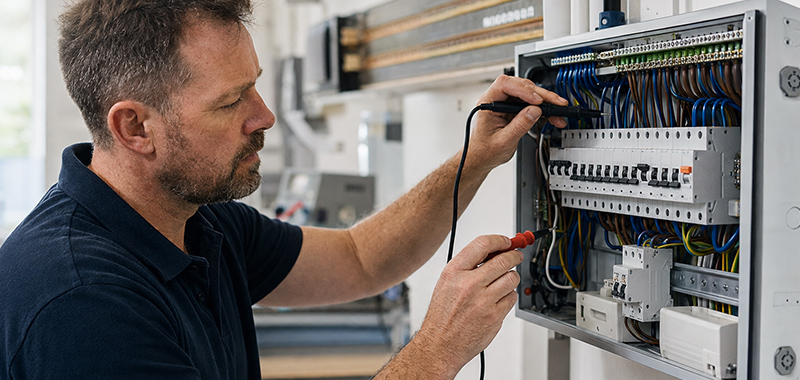
For some experienced electricians, obtaining an ECS Gold Card can present a significant challenge.
You may have spent ten years or more working in the electrotechnical industry, completing installations, testing systems, supervising projects or running your own electrical business, but never completed a recognised electrical diploma.
Despite having extensive practical experience, the absence of an accepted Level 2 underpinning technical qualification can prevent you from meeting the standard entry requirements for the Experienced Worker Assessment.
Historically, this has created a barrier for electricians who developed their knowledge and skills through years of practical industry experience but never formally completed a recognised Level 2 or Level 3 electrical diploma.
The EWA Entry Test provides an additional entry route for a specific group of highly experienced, practising electricians. It is intended for candidates who do not hold an accepted Level 2 underpinning technical qualification but may have developed the required technical knowledge through substantial industry experience.
Official guidance describes suitable candidates as normally having at least ten years’ experience as practising electricians. However, experience alone does not guarantee entry. Each candidate must complete an individual eligibility and knowledge assessment before being approved for the test.
Jump to:
What is the experienced worker assessment?
The Experienced Worker Assessment, commonly referred to as the EWA, is an assessment route for practising electricians with substantial industry experience who have not completed a recognised electrotechnical apprenticeship or achieved an equivalent Level 3 competency-based qualification.
For the Installation and Maintenance Electrician route, candidates work towards the Level 3 Electrotechnical Experienced Worker Qualification.
Although the term “NVQ” is widely used when discussing this route, the formal qualification title should be used in official communications and documentation.
The EWA is aligned with the occupational standard covered by the relevant apprenticeship. It assesses whether the candidate can demonstrate the required knowledge, practical skills and occupational competence.
It is not a shortened training course or an easier alternative to an apprenticeship. Candidates must already be experienced electricians and must be able to demonstrate competence through current workplace evidence.
After completing the Experienced Worker Qualification, the AM2E assessment and the remaining ECS requirements, the candidate may become eligible to apply for an ECS Installation Electrician Gold Card.
Why was the EWA entry test introduced?
The electrotechnical industry includes electricians who have developed substantial practical skills and technical knowledge without completing a recognised electrical diploma.
Some entered the industry informally and built their careers by working alongside experienced tradespeople. Others may have progressed from related roles and gradually taken on increasingly complex electrical work.
These individuals may have worked competently in the industry for more than a decade but remain unable to meet the standard EWA entry requirements because they do not hold an accepted Level 2 underpinning technical qualification.
The EWA Entry Test was introduced to provide a controlled alternative entry route for suitably experienced candidates.
It allows an eligible electrician to demonstrate that they already possess the breadth and depth of underpinning technical knowledge required to begin the Experienced Worker Assessment.
The route is not intended for new entrants, trainees or people with limited electrical experience. It is also not intended to replace Level 2 qualifications as the normal route into the industry.
It is specifically for experienced, practising electricians who can demonstrate extensive industry experience and technical knowledge but who never completed an accepted Level 2 underpinning electrical qualification.
Who may be eligible?
The EWA Entry Test may be appropriate where a candidate:
- Has normally accumulated at least ten years of substantial practical experience as an electrician
- Is currently working within the electrotechnical industry
- Does not hold an accepted minimum Level 2 underpinning technical qualification listed in the relevant EWA Skills Scan
- Has developed a broad understanding of electrical theory and installation work through industry experience
- Currently works across the range of activities required by the relevant Experienced Worker Assessment
- Can provide evidence of their industry experience and current occupational role
- Can generate suitable current workplace evidence within the EWA registration period
- Successfully completes the Skills Scan, Candidate Background Form and provider verification process
Ten years of experience alone does not automatically make someone eligible.
The training provider must review the candidate’s experience, knowledge, current work and any qualifications or certificates they already hold.
The provider must then submit the application for approval before the Entry Test can be booked.
What about older electrical qualifications?
The EWA Entry Test should not generally be presented as the route for electricians who hold older qualifications.
Some historical Level 2 electrical qualifications are still accepted for standard EWA entry where they are listed in the current Skills Scan.
If an electrician holds an older qualification, the certificate should first be reviewed against the relevant EWA entry requirements.
Where a qualification is not listed, the training provider may need to seek guidance or approval from TESP before deciding which pathway is appropriate.
The Entry Test is primarily intended for electricians who do not hold an accepted Level 2 underpinning technical qualification, rather than those whose existing qualifications may already provide access to another EWA route.
Specialist certificates, such as BS 7671 or inspection and testing qualifications, do not normally replace the full underpinning technical qualification required for standard EWA entry.
What is the EWA entry test?
The EWA Entry Test evaluates whether an experienced electrician has sufficient underpinning technical knowledge to progress to the Experienced Worker Assessment without first completing the normally required Level 2 qualification.
Depending on the awarding organisation, the assessment may be delivered as the City & Guilds Experienced Worker Entrance Test or through the relevant EAL underpinning knowledge and understanding tests.
The assessment is intended to confirm knowledge that the candidate has already developed. It is not a training programme designed to teach missing electrical theory immediately before the test.
Areas assessed may include:
- Workplace legislation
- Health and safety
- Establishing and maintaining a safe working environment
- Hazard identification and risk control
- Electrical science and calculations
- Electrical circuits, systems and components
- Electrical installation practices
- Wiring systems and containment
- Supply systems and consumers’ equipment
- Earthing and protective measures
- Electrical design principles
- Safe isolation
- Inspection, testing and commissioning
- Application of BS 7671
- Use of the IET On-Site Guide
The assessment includes technical theory, scientific principles and design-related knowledge.
Candidates must therefore be able to demonstrate more than practical familiarity with electrical installation work. They must understand the principles supporting safe and compliant electrical practice.
What happens after the entry test?
Passing the EWA Entry Test does not award an NVQ, an Experienced Worker Qualification, an AM2E or an ECS Gold Card.
It provides an approved entry route to the Experienced Worker Assessment for an eligible candidate who does not hold the normally required Level 2 underpinning qualification.
Candidates who successfully pass the Entry Test must enrol on the appropriate Experienced Worker Assessment within the required period. Current guidance states that enrolment should take place within six months of passing the test.
The experienced worker assessment process
step 1
Eligibility review
The candidate completes the relevant Skills Scan and Candidate Background Form.
The training provider reviews:
- Previous and current electrical employment
- Length and breadth of industry experience
- Existing qualifications and certificates
- Current occupational role
- Technical knowledge
- Ability to generate evidence across the required scope of work
The provider must be satisfied that the candidate is suitable for the route before submitting the application for approval.
step 2
Entry test approval and assessment
The provider submits the verified application for approval.
The EWA Entry Test can only be booked once approval has been granted.
The candidate must then successfully complete the required knowledge assessment.
step 3
EWA Registration
After passing the Entry Test, the candidate must register on the relevant Experienced Worker Assessment within six months.
The EWA is normally expected to be completed within an 18-month registration period.
This period covers the Experienced Worker Qualification and the submission of the gateway application for the AM2E.
The AM2E itself may take place after the 18-month point where the qualification and gateway requirements were completed within the permitted registration period.
step 4
Level 3 performance units
The candidate completes performance units by providing evidence from current electrical work.
For the Installation and Maintenance Electrician route, this includes competence in areas such as:
- Health, safety and environmental considerations
- Organising and overseeing the electrical work environment
- Electrical design and installation practices
- Terminating and connecting conductors
- Inspection, testing and commissioning
- Fault diagnosis and rectification
The qualification assesses the candidate’s performance in the workplace rather than relying solely on written knowledge tests.
step 5
Current workplace evidence
Performance evidence must be generated from current electrical work completed after registration on the Experienced Worker Assessment.
Previous work may be considered when determining whether the candidate has sufficient experience to enter the pathway. However, it cannot normally replace the current evidence required for the performance units.
Evidence may include:
- Photographs and videos
- Electrical installation certificates
- Electrical Installation Condition Reports
- Test results
- Risk assessments and method statements
- Job specifications
- Drawings and design information
- Supporting workplace documentation
The evidence must relate to genuine work carried out by the candidate and must demonstrate competence across the required range of activities.
step 6
Workplace assessment
An assessor reviews the candidate’s portfolio and evaluates their occupational performance.
At least one performance assessment must take place live and in person on site, with the assessor and candidate physically present at the same location.
This provides direct evidence that the candidate can complete electrical work safely and competently in a genuine workplace environment.
step 7
Additional qualification requirements
Installation and Maintenance Electrician EWA candidates must also meet the applicable requirements relating to:
- The current edition of BS:7671
- Initial Verification of Electrical Installations
Where the candidate has already completed accepted qualifications, the provider will need to confirm whether they can be recognised.
Where the requirements have not already been met, the relevant qualifications must be completed as part of the overall pathway.
step 8
AM2E assessment
After achieving the Experienced Worker Qualification and meeting the gateway requirements, the candidate must complete the AM2E at a NET-licensed assessment centre.
The AM2E is the Experienced Worker version of the industry assessment of occupational competence.
It should not be confused with the standard AM2 taken by candidates completing other qualification or apprenticeship routes.
step 9
ECS Gold Card Application
After completing the Experienced Worker Qualification, AM2E and the other applicable ECS requirements, the candidate may apply for an ECS Installation Electrician Gold Card.
Applicants must also satisfy requirements relating to:
- The current edition of BS 7671
- A valid ECS Health, Safety and Environmental Assessment
- The relevant occupation and card criteria
Completing the EWA route establishes eligibility to apply. It does not mean that a Gold Card is issued automatically.
What are the potential benefits?
For an eligible experienced electrician, completing the route may provide:
- Formal assessment of occupational competence
- A recognised Level 3 competency-based qualification
- Eligibility to progress to the AM2E
- A route towards applying for an ECS Installation Electrician Gold Card
- Recognised evidence of competence for employers, contractors and clients
- Access to roles or sites requiring recognised competency credentials
- Greater professional recognition of skills developed through industry experience
Individual employment, contractual and earnings outcomes cannot be guaranteed.
Frequently Asked Questions
IS THE ENTRY TEST AVAILABLE TO ANYONE WITH TEN YEARS’ EXPERIENCE?
No.
Ten years is a normal experience benchmark rather than an automatic entitlement.
The candidate must also demonstrate substantial technical knowledge, complete the relevant eligibility documentation, work across the required scope and receive approval before the test can be booked.
CAN I USE THIS ROUTE IF I HAVE LESS THAN TEN YEARS’ EXPERIENCE?
Official guidance describes candidates as normally having at least ten years’ substantial industry experience.
Candidates with less experience may need to use another qualification or training route.
Where an accepted Level 2 qualification is held, the standard Experienced Worker Assessment entry route may be available once the separate experience and eligibility requirements have been met.
IS THIS ROUTE FOR ELECTRICIANS WITH OLDER QUALIFICATIONS?
Not necessarily.
Older qualifications should first be reviewed against the current EWA Skills Scan. Some historical qualifications remain accepted for standard EWA entry.
Where a qualification is not listed, the provider should seek guidance before deciding whether the Entry Test or another pathway is appropriate.
DO BS 7671 OR INSPECTION AND TESTING QUALIFICATIONS MEET THE LEVEL 2 ENTRY REQUIREMENT?
Not by themselves.
These are specialist qualifications and do not normally replace the underpinning technical certificate required for standard EWA entry.
They may, however, contribute towards other requirements within the overall pathway.
DOES PASSING THE ENTRY TEST GIVE ME AN NVQ?
No.
Passing the test allows an eligible candidate to enrol on the Experienced Worker Assessment.
The candidate must still complete the Level 3 Experienced Worker Qualification, provide current workplace evidence, complete the required assessments and successfully undertake the AM2E.
DO I STILL NEED TO COMPLETE THE AM2?
Installation and Maintenance Electrician EWA candidates must complete the AM2E.
The AM2E is the appropriate industry competence assessment for the Experienced Worker route.
CAN PREVIOUS WORK BE USED IN MY PORTFOLIO?
Previous work may help demonstrate that you have sufficient experience to be considered for the pathway.
However, performance evidence for the Experienced Worker Qualification must come from current work undertaken after EWA registration.
CAN OVERSEAS EXPERIENCE BE CONSIDERED?
Relevant overseas work may be considered when reviewing a candidate’s general industry background and overall experience.
However, the performance evidence used within the EWA must relate to current work completed in the UK.
Non-UK qualifications must be assessed through the appropriate industry recognition process before they can be considered for ECS purposes.
Final Thoughts
The EWA Entry Test provides a controlled entry route for a specific group of experienced, practising electricians.
It is intended for individuals who have normally accumulated at least ten years of substantial practical experience and technical knowledge but who do not hold an accepted Level 2 underpinning electrical qualification.
It is not a shortcut, a substitute for experience or an automatic route to an ECS Gold Card.
Candidates must demonstrate their suitability for the pathway, pass the Entry Test, complete the full Experienced Worker Qualification using current workplace evidence, meet the relevant BS 7671 and Initial Verification requirements, complete the AM2E and satisfy the remaining ECS criteria.
For electricians who meet these requirements, the route provides an opportunity to have knowledge and competence developed over many years assessed against the current industry standard.
Sources and further reading
- The Electrotechnical Skills Partnership, EWA Entry Test Overview and Application Form.
- The Electrotechnical Skills Partnership, Experienced Worker Assessment eligibility guidance and frequently asked questions.
- City & Guilds, Installation and Maintenance Electrician — Experienced Worker Entrance Test, qualification code 2346-04: Test Guidance.
- City & Guilds, Level 3 Electrotechnical Experienced Worker Qualification, qualification code 2346-03.
- Electrotechnical Certification Scheme, Installation Electrician Gold Card requirements.
- Electrotechnical Certification Scheme, guidance for applicants holding non-UK qualifications.
Author: Greg Oliver
All material claims were reviewed against the primary industry sources listed above before publication. Final eligibility decisions remain subject to the relevant awarding organisation, TESP, ECS and training-provider requirements.