
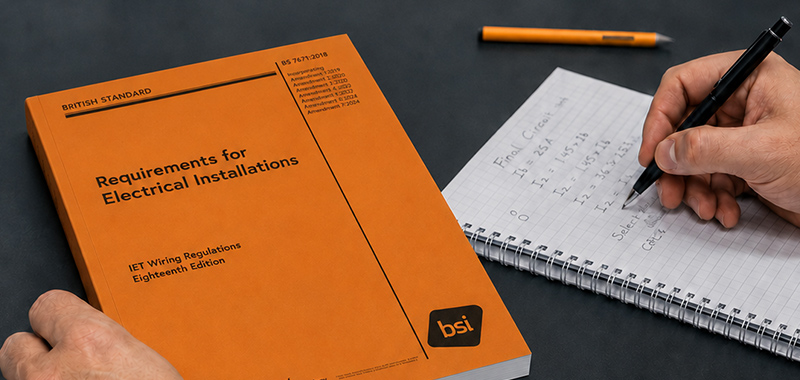
The publication of the Fourth Amendment to the 18th Edition of the IET Wiring Regulations (BS 7671) introduces a number of important updates that reflect changes in technology, installation practice and industry requirements. Published on 15 April 2026, the amendment includes a transition period until 15 October 2026, after which new work should comply with the updated requirements.
Rather than replacing the 18th Edition, the Fourth Amendment updates specific parts of BS 7671. Many of the existing requirements remain unchanged, but several regulations, chapters and appendices have been revised or introduced.
Jump to:
When Does the Fourth Amendment Come Into Effect?
The Fourth Amendment was published on 15 April 2026. A transition period applies until 15 October 2026, after which new electrical installation work should be designed, installed, inspected and tested in accordance with the amended requirements.
New Definitions
Part 2 has been updated with additional definitions to improve consistency and support new requirements introduced elsewhere within BS 7671.
Protective Neutral Bonding (PNB)
Regulation 312.2.1.1 has been updated to include a Protective Neutral Bonding (PNB) figure together with associated requirements.
Protection Against Thermal Effects
Chapter 42 has been revised in relation to high-rise residential buildings and protected escape routes. The amendment also clarifies the types of cables permitted within protected escape routes and when cables installed within fire-resisting enclosures are deemed to be outside the protected escape route.
Overcurrent Protection
Changes have been made to overcurrent protection requirements, including the introduction of the term ‘inherently short-circuit and earth fault proof’ in relation to conductor selection.
Conductor Identification
Table 51 has been revised to include identification requirements for combined protective and functional earthing conductors, combined protective and functional bonding conductors, and functional bonding conductors.
Wiring Systems
Changes have been made to requirements for wiring systems, including revisions to Regulation 521.10.202 and Table 52.1.
ICT Functional Earthing
Section 545 introduces additional requirements covering functional earthing and functional equipotential bonding for ICT equipment and systems.
Low Voltage Generating Sets
Section 551 has been revised, including changes relating to bidirectional energy flow, generating sets and the coordination of generating equipment connected in parallel with another source.
New Chapter 57 – Stationary Secondary Batteries
A completely new Chapter 57 has been introduced covering stationary secondary battery installations. It sets out requirements for installations where the designed purpose is the storage and supply of electrical energy.
Periodic Inspection and Testing
Requirements relating to periodic inspection and testing have been updated, including notes for report authors and recipients, references to photographs and thermographic images, and revisions to Appendix 6 model forms.
New Section 716 – Power over Ethernet
A new Section 716 has been introduced covering Power over Ethernet (PoE) and extra-low-voltage DC power distribution using balanced information technology cabling.
New Chapter 81 – Energy Efficiency
Chapter 81 has been introduced covering the functional aspects of energy efficiency and signposts designers to the relevant Building Regulations and BS HD 60364-8-1.
Medical Locations
Section 710 has been revised with updates relating to medical locations.
Electromagnetic Disturbances
Annex B443 has been deleted as part of the amendment.
Appendices
Appendix 13 has been updated with guidance relating to cables in protected escape routes. Appendix 17 has been deleted and its subject matter replaced by Chapter 81.
Updated Certification
Model forms within Appendix 6 have been revised, including report notes, signatures and coding to reflect the Fourth Amendment.
What Do These Changes Mean for Electricians?
Electricians should familiarise themselves with the revised chapters and regulations before the end of the transition period, review how the changes affect the type of work they undertake, and ensure they are working to the current edition of BS 7671 when required.
Frequently Asked Questions
When was the Fourth Amendment published?
15 April 2026.
When does the transition period end?
15 October 2026.
What are the most significant additions?
New Chapter 57 (Stationary Secondary Batteries), Section 716 (Power over Ethernet) and Chapter 81 (Energy Efficiency).
Do I need to understand the changes?
Anyone designing, installing, inspecting or testing electrical installations should become familiar with the updated requirements.
Final Thoughts
The Fourth Amendment updates a number of important areas within the 18th Edition Wiring Regulations. Although many existing requirements remain unchanged, electricians should understand the revised regulations and new chapters so that future work complies with the latest edition of BS:7671.
Author: Greg Oliver