
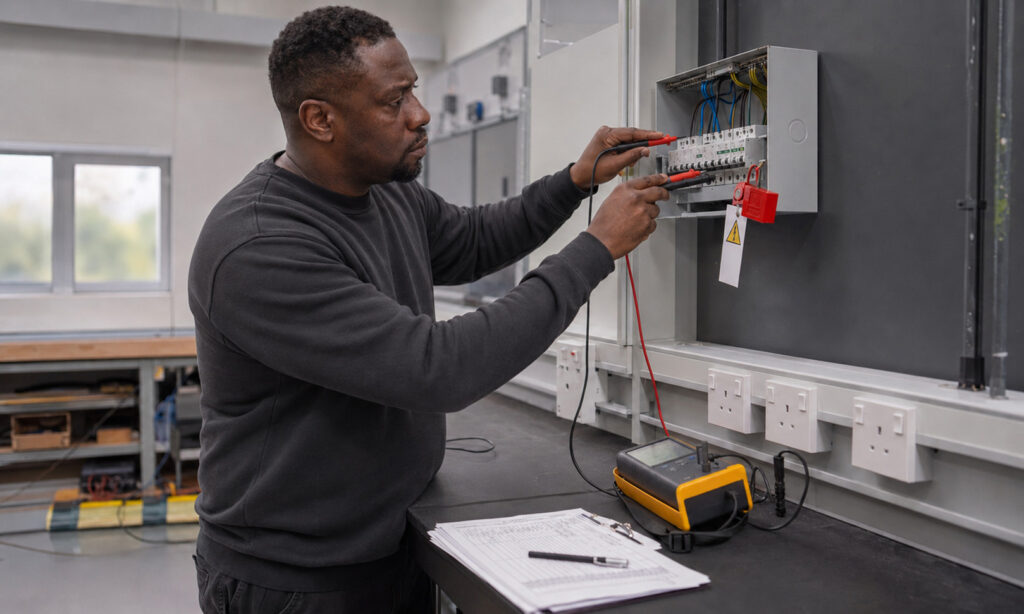
Inspection and testing forms a critical part of an electrician’s responsibilities.
Whether you are carrying out initial verification on a new installation, or undertaking periodic inspection and testing, accuracy and understanding of results is essential.
However, even experienced electricians can make mistakes.
In many cases, these errors can lead to failed assessments, incorrect verification, unsafe installations, or costly and unnecessary remedial work.
This article explores some of the most common inspection and testing mistakes made by electricians, particularly during their 2391 assessments, and provides practical advice on how to avoid them.
Jump to:
Why Is Inspection and Testing So Important?
Inspection and testing verifies that a new electrical installation is safe to be energised or an existing installation is safe for continued use.
The process confirms that:
- The installation complies with the design criteria or with BS 7671 (where applicable).
- Electrical equipment has been selected and installed correctly.
- Protective measures are effective.
- Faults or defects which may give rise to danger have been identified.
- Appropriate reports or certification can be issued.
Ultimately, inspection and testing is about ensuring safety, compliance, and confidence in the installation.
1 - Failing to Follow the Correct Sequence of Testing
One of the most common mistakes is carrying out tests in the wrong order.
BS 7671 sets out a recommended sequence for inspection and testing, beginning with dead testing before progressing to live testing.
Typical dead tests include:
- Continuity of protective conductors.
- Continuity of ring final circuit conductors.
- Insulation resistance.
- Polarity.
Only once these tests have been completed satisfactorily should live testing commence.
Carrying out tests in the incorrect order can create unnecessary risks and may invalidate results. It should be noted that during periodic inspections, the typical sequence of testing may be altered to account for limitations, sampling & engineering judgement, however considerations should still be given to the manner and order in which certain tests that have been identified as necessary are carried out.
2 - Poor Safe Isolation Procedures
Safe isolation is fundamental to electrical safety. Unfortunately, complacency often leads to errors.
Common mistakes include:
- Failing to prove the voltage indicator before use.
- Not re-proving the instrument after testing.
- Relying solely on switching off a circuit.
- Failing to use appropriate lock-off equipment.
- Using unsuitable test equipment.
- Testing on the incorrect side of an accessory or switch
- Not retaining the key on their person or in a secure manner that prevents unauthorised re-energisation.
Electricians should always follow a structured safe isolation procedure and use approved equipment.
3 - Misinterpreting Test Results
Obtaining a test reading is only part of the process. Electricians must also understand what the results mean.
Examples include:
- Failing to understand the importance of expected test results during step 2 of ring final continuity testing.
- Confusing Ze and Zs values.
- Failing to compare measured Zs results against maximum permitted values adjusted for temperature.
- Failing to account for R1+R2 values when establishing Zdb at sub-mains.
- Failing to correctly adjust PSCC values on 3-phase systems to account for simultaneous short circuit conditions.
- Misunderstanding RCD test results.
A test result that appears acceptable at first glance may indicate a problem when assessed correctly.
Understanding the principles behind the tests as well as the operation of the instrument used is therefore essential.
4 - Inaccurate Completion of Certificates or Reports
Electrical certification or reporting carries legal significance. Unfortunately, errors on certificates and reports are extremely common.
Typical mistakes include:
- Missing information.
- Incorrect circuit references.
- Incomplete schedules of test results.
- Incorrect protective device details.
- Missing signatures.
- Incorrectly calculated values documented.
- Non-compliances ignored on EIC’s.
- Incorrect classification codes assigned to condition reports.
Certification and condition reports should always be checked carefully before being issued.
Many electricians find that completing paperwork slowly and methodically significantly reduces errors.
5 - Weak Knowledge of BS 7671
Inspection and testing requires more than practical ability. Electricians must also understand the requirements of BS 7671 and know how to reference the regulations effectively.
Common issues include:
- Difficulty locating information quickly.
- Misinterpreting and Misapplying regulations.
- Relying solely on (outdated) memory.
- Using outdated or incorrect publications.
- Not understanding requirements around protective measures in their entirety.
- Failing to understand the significance of the language used in BS 7671.
Regular use of the Wiring Regulations and associated guidance publications helps maintain competence.
6 - Not Understanding the Purpose of the Test
Some electricians focus entirely on obtaining readings without fully understanding why the test is being carried out.
For example:
- Continuity testing confirms the integrity of protective conductors as well as measuring the resistance values. These values are later used to establish Zs values which will verify disconnection times of protective devices.
- Insulation resistance testing confirms separation between conductors.
- Polarity ensures that line conductors are connected in the switch or protective devices.
- Earth electrode testing ensures a stable resistance to earth is ensured for the installation.
- Earth fault loop impedance testing confirms disconnection requirements can be met.
- RCD testing confirms these protective devices operate within required times and are respondent to their residual current ratings.
Understanding the purpose of each test enables electricians to identify problems more effectively.
7 - Poor Preparation for Assessment
Candidates undertaking qualifications such as the City & Guilds 2391 often underestimate the level of preparation required.
Common assessment mistakes include:
- Rushing.
- Poor time management.
- Forgetting test sequences.
- Inaccurate paperwork.
- Weak understanding of testing theory.
Successful candidates typically prepare thoroughly and practise testing procedures regularly before attending assessment. Where candidates have no or little testing experience, it is recommended that they either undertake the 2392 L2 course first or gain a comfortable amount of experience in testing and certification prior to attending a 2391 course. This ensures that candidates have the required foundational knowledge and the skills needed to cope with the course content and the assessments that follow.
How Can Electricians Improve Their Inspection and Testing Skills?
Electricians can improve by:
- Following the correct testing sequence where applicable.
- Regularly reviewing BS 7671 and Guidance Note 3.
- Practising test procedures in realistic environments.
- Checking all certification and reports carefully.
- Continuing professional development through training and technical updates.
Inspection and testing is a skill that develops through both knowledge and experience.
Frequently Asked Questions
What is the most common inspection and testing mistake?
Poor safe isolation procedures and incorrect test sequences are among the most common mistakes, as well as an insufficient understanding on how to complete model forms manually.
Why is certification important?
Electrical certificates provide formal evidence that an installation has been inspected, tested, and found to comply with the relevant standards. In the event of a dispute, paperwork will form a large part of an electricians defence.
Do I need to memorise every regulation?
No. However, electricians should understand the principles behind the regulations and be able to locate information efficiently.
How can I improve my testing knowledge?
Regular practice, continuing professional development, and structured training can all help improve competence.
Final Thoughts
Inspection and testing remains one of the most important responsibilities undertaken by electricians.
Whilst mistakes can occur, many of the most common errors are avoidable through structured procedures, sound technical knowledge, and attention to detail.
Developing strong inspection and testing skills not only supports compliance but also helps ensure that electrical installations remain safe for those who use them.
Author: Dylan Weyers